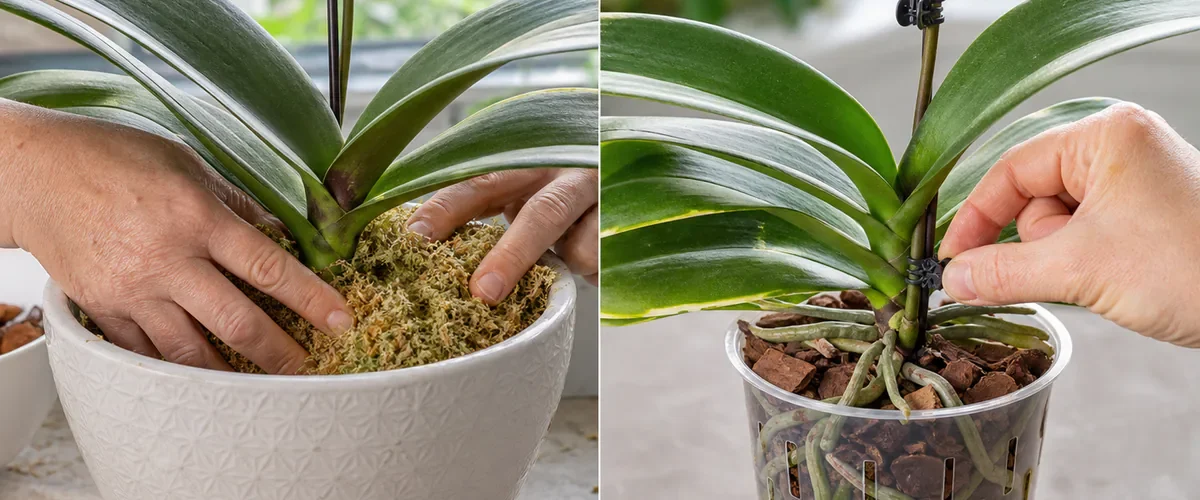
The repotted orchid leans when the pot is moved. You add another handful of bark, press the plant lower, and the wobble disappears. The leaves now sit close to the damp surface, but the pot looks neat.
Stability came at the wrong cost. A Phalaenopsis crown needs air and must stay above the potting medium. Your orchid wobbles after repotting until you fix the support, not until you bury the plant’s growing point.
Find the Crown and Lowest Leaf Bases
The crown is the central point where new Phalaenopsis leaves emerge. It sits above the short stem and root system. Water held inside it can lead to serious rot.
The lowest leaves should rest at or above the top of the bark. Roots may enter the medium or remain in the air. Aerial roots are not untidy mistakes that must be forced into the container.
Decide Whether Repotting Was Needed
Repot when bark has decomposed, holds water too long, smells sour, or roots no longer fit or function well. A healthy plant can also need a more stable pot after growth shifts its weight.
Do not repot simply because flowers ended yesterday or because a larger decorative pot is available. A bigger container around a small root system can remain wet. Budding orchids may drop flowers after unnecessary disturbance.
Time the Work Around Root Growth
After flowering or when new root tips begin is often a practical time for a Phalaenopsis. The new roots can enter fresh medium. Species and conditions differ, so identify the orchid when possible.
Choose Air Before Decoration
Use a slotted or ventilated orchid pot only slightly larger than the useful root mass. Clear sides help you see roots and moisture. Place that pot inside a decorative cover only if drainage water can be emptied and air can move.
Choose fresh coarse orchid bark or a mix made for the species and home environment. Garden soil and dense standard potting mix shut away the air epiphytic roots need.
Free the Roots Gently
Ease the orchid from its old container. Cut a disposable pot when roots cling to drainage holes rather than pulling hard. Loosen broken-down bark and inspect each root by feel.
A useful root is firm and can appear green, silver, cream, or tan. A dead root may be mushy, hollow, or papery. Trim only dead tissue with clean disinfected scissors. Keep firm aerial roots even if they point in an awkward direction.
Set Height Before Adding Bark
Hold the orchid so its lowest leaf bases stay just above the planned surface. Arrange flexible roots naturally inside the pot. Let stiff aerial roots remain outside instead of bending them until they crack.
Add bark around the roots in small amounts. Tap the container to settle pieces into gaps. Do not crush the bark, stuff the crown, or build a mound over the stem.
Correct a Deep Plant Immediately
If the crown is already buried, lift the orchid and reset it before repeated watering. Remove bark trapped between leaves and blot away moisture. Inspect the stem for soft dark tissue or odor.
Isolate an orchid with spreading rot and seek experienced advice. Repotting alone cannot replace dead crown tissue.
Stop Wobble With a Temporary Support
Use an orchid pot clip, rhizome clip, or clean stake suited to the container. Secure the plant gently without piercing roots or squeezing the stem. The support should stop movement while fresh roots attach.
Remove or adjust the device when the orchid anchors itself. A clip is safer than burying leaf bases and easier to change than packed medium.
Water the Roots and Protect the Crown
Water when the bark and roots approach their normal dry stage, then wet the root zone thoroughly and drain. Do not leave the pot in a saucer or decorative cover full of water.
Avoid pouring into the leaf center. If water enters, blot it with a clean paper-towel corner, especially in a cool room with little airflow. Do not use ice as a substitute for full, even watering.
Let Recovery Come Before Flowers
Place the orchid in bright indirect light with stable warm conditions. Avoid hot sun, cold glass, and heating vents. Keep it in one suitable place while the roots recover.
When active healthy growth returns, use a complete water-soluble fertilizer at a gentle label-directed concentration. Flush salts as appropriate. Kitchen scraps and strong bloom formulas do not make an unstable root system ready to flower.
Five Signs the Height Is Correct
- The crown remains open and dry
- No bark is wedged between leaves
- Firm roots contact airy medium
- The support stops movement without pressure
- New green root tips begin to grip the pot
Your orchid wobbles after repotting until you fix this one height mistake. Set the roots in bark, keep leaf bases and crown above it, and use a clip for temporary stability. The plant may take months to bloom, but every future flower begins with a growing point that was never buried for appearances.


