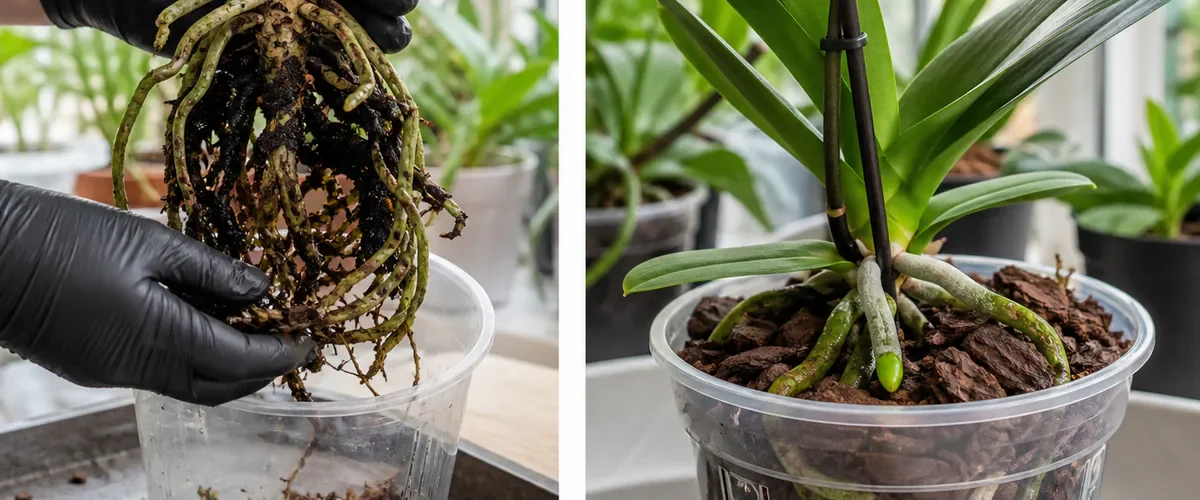
When an orchid refuses to grow, most people stare at the empty flower spike. The useful clue is lower. Lift the clear pot toward a window and inspect the roots. One change to that root zone—restoring air around firm living roots—can begin the fastest honest comeback the plant can make.
A moth orchid does not need cucumber juice, starchy rice water, or a weekly peroxide spray. It needs the conditions that let roots breathe, absorb water, and support the next leaf.
Learn the Colors of Orchid Roots
Dry healthy Phalaenopsis roots often look silver or pale. After watering, many turn green. Fresh growing tips may be bright green and smooth. Firm texture matters more than an exact shade.
Dead roots feel papery, hollow, or mushy and may pull apart. A sour smell, dense crumbling bark, and a pot that remains wet for many days suggest trouble. Wrinkled leaves do not always mean the orchid needs more water; damaged roots may be unable to drink from an already wet pot.
Decide Whether Repotting Is Necessary
Repot when the bark has broken down, many roots are rotting, or the plant no longer fits safely. If bark is still open and roots are sound, changing the watering and light may be enough.
Prepare fresh orchid bark, a clean vented pot only slightly larger than the living root mass, and sterilized scissors. Ease the plant free, remove old mix, and rinse only if needed to see the roots. Cut soft dead sections, keeping every firm root.
Set the orchid so the crown stays above the mix. Work bark around the roots without crushing it into a solid block. Epiphytic orchid roots need gaps filled with air.
Change the Watering Question
Instead of asking whether today is watering day, ask whether the roots are approaching dryness. Feel the pot’s weight and look through the container. Conditions can change with season, temperature, and light.
When water is needed, carry the inner pot to the sink and run room-temperature water through the bark. Wet the full root zone, then drain completely. Pour water from the decorative pot and blot any drops caught in the crown.
Do not use ice. It gives a cold, uneven dose and can leave much of the bark dry. Do not keep a small reserve of water beneath the pot.
Give Roots Energy Through the Leaves
Roots do not work alone. The leaves need bright indirect light to power growth. An east window is often suitable for a moth orchid. A sheer curtain can soften a bright southern or western exposure.
Move the orchid gradually and watch the leaf color. Bleached patches suggest too much direct sun. Very dark leaves and no growth can accompany low light. Clean dust from leaves without letting water collect at their bases.
Gentle room airflow helps bark dry evenly. Avoid cold drafts and strong hot air from a vent.
Feed the Plant, Not the Potting Bark
During active root and leaf growth, apply a complete orchid fertilizer at the label rate. Weak, regular nutrition is easier on roots than rare heavy doses. Flush occasionally with plain water to wash out accumulated salts.
Wait to feed a severely rootless or rotting plant until its care is stable. Fertilizer is not medicine, and extra salts can damage fragile tissue.
Why the Natural Mixture Is Risky
Rice water contains starch, and cucumber peel liquid leaves organic residue. In an airy orchid pot, those materials can decay, support mold, smell, and attract fungus gnats. Their nutrient strength is unknown and incomplete.
Hydrogen peroxide may damage living tissue when used repeatedly. The brief bubbles do not permanently aerate decomposed bark. Replace failed material instead of trying to chemically rescue it.
Keep food mixtures away from the leaves and crown. Clean water, clean tools, and a labeled fertilizer give you more control.
Watch for the Sequence of Recovery
A recovering orchid may stabilize before it visibly grows. Leaves stop worsening. Root tips become active. A new leaf slowly rises from the center. A flower spike usually comes after the plant has enough stored energy and receives the seasonal signals its hybrid needs.
Do not cut aerial roots simply because they leave the pot. They are normal. Do remove fully brown flower spikes with clean scissors, and support the pot so heavy leaves do not tip it.
The Root-Zone Change That Pays Off
The quickest orchid comeback is still measured in weeks, not hours. Air around roots, full drainage, correct watering, useful light, and restrained feeding create the conditions for that recovery.
When the first green tip appears against the clear pot, it may look small compared with a spray of flowers. It is actually the beginning of everything the orchid can build next.
Mark the date and take a photograph. Comparing that tip after two weeks will show progress without tempting you to disturb the roots again.


